2025 MID-YEAR
Statutory and paid leave

Report Objectives
data parameters
Our practice team uses JURIS and TAMS claims data to perform comparative analyses informed by their expertise and analytics. The data in this report is based on the first half of each year, January through June, for each reporting year.
Certain client data is excluded from book of business metrics to avoid overrepresentation of a single client. Detailed analysis is included for California, Colorado, Connecticut, Massachusetts, New Jersey, New York, Oregon and Washington.
Key observations
8.1%
Increase overall in new claim volume
10.3%
6.1%
Increase in California Paid Family Leave (CAPFL) claims year over year
This is the second largest contributor to statutory paid leave claims, with an incident rate that remained stable at 5.2.
Age group trends
The 25-35 and 35-45 age groups remained the most active users across all state programs.
- For NYPFL, usage in the 35-45 group increased from 39% to 39.9%.
- For CAPFL, usage in the 35-45 group represented 47.3% of new claims, followed by 25-35 at 36.2%.
- The 55-plus age group is emerging as a growing segment:
- Overall usage of statutory paid leave grew from 9% to 9.7% for this age group.
- NYPFL usage in those who are 55 or older increased from 11.5% to 12.1%, primarily for family leave.
Length of service (LOS) trends
- Employees in the “5–10 years” category showed the highest usage. Usage increased from 28.3% to 29.8%.
- Usage by employees in the “less than 3 years” category declined from 33.1% to 28.4%, though this age group still represents a significant portion of usage.
Claim type insights
NYPFL
- Family leave: 47.3% of claims
- Bonding with newborn: 52.3%
- Claim frequency:
- Continuous: 55%
- Periodic: 45%
CAPFL
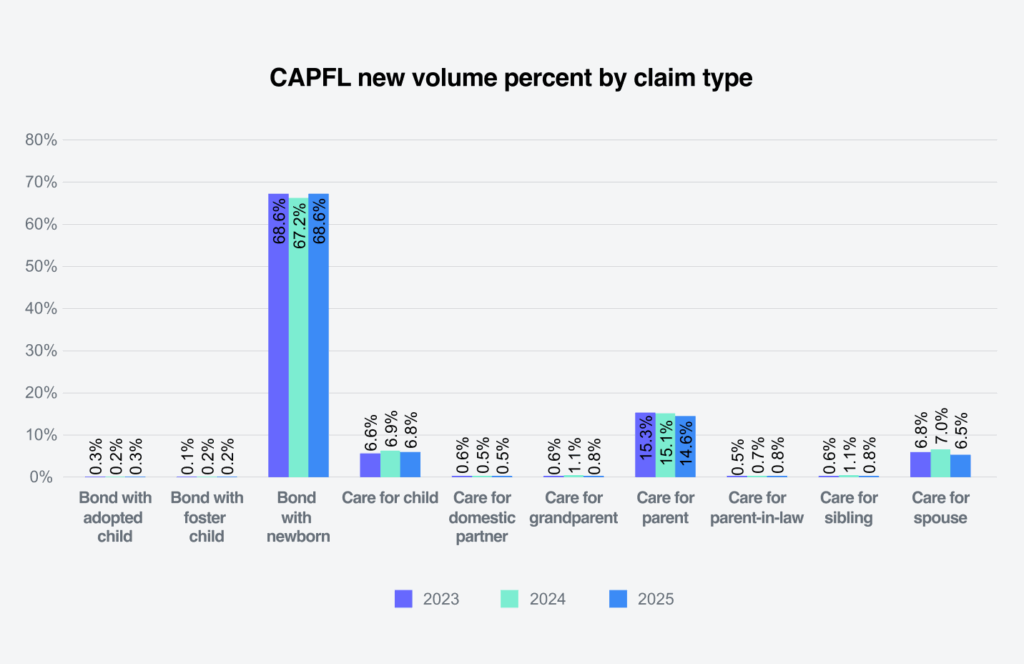
- Bonding with newborn: 68.6%
- Care for parent: 14.6%
Download a summary slide with these key observations.
REPORT CONTENTS
New volume for statutory paid family leave
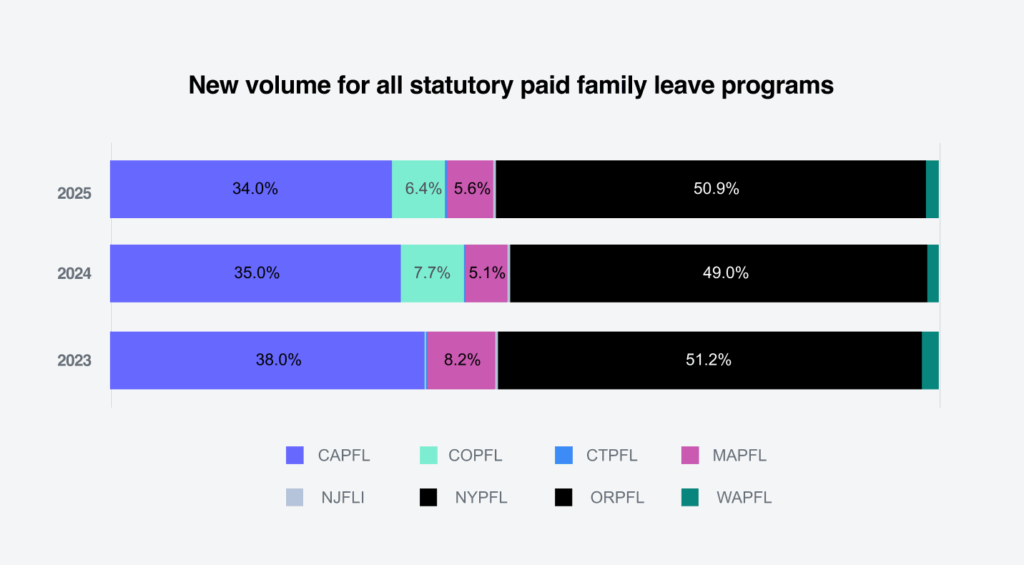
Paid family leave by state
New York
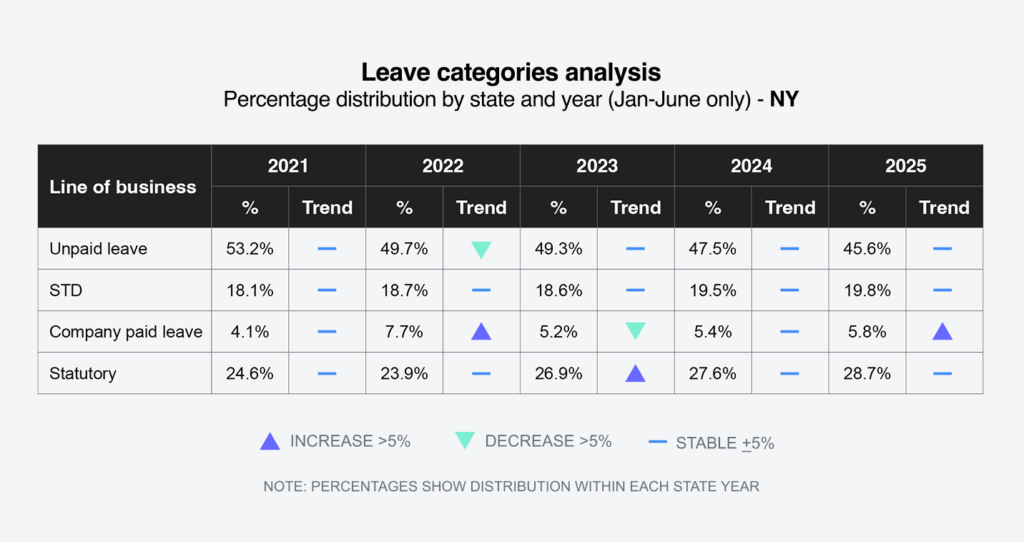
When comparing New York to Sedgwick’s overall book of business, statutory NYPFL and New York Disability Benefits Law (NYDBL) claims have remained consistent over the last two years. The trend we’re watching is the increase in company paid leaves. While company paid leaves dropped significantly in 2023, they now appear to be slowly increasing again — which we attribute to an increase in companies adding paid family leave in addition to traditional parental leaves.
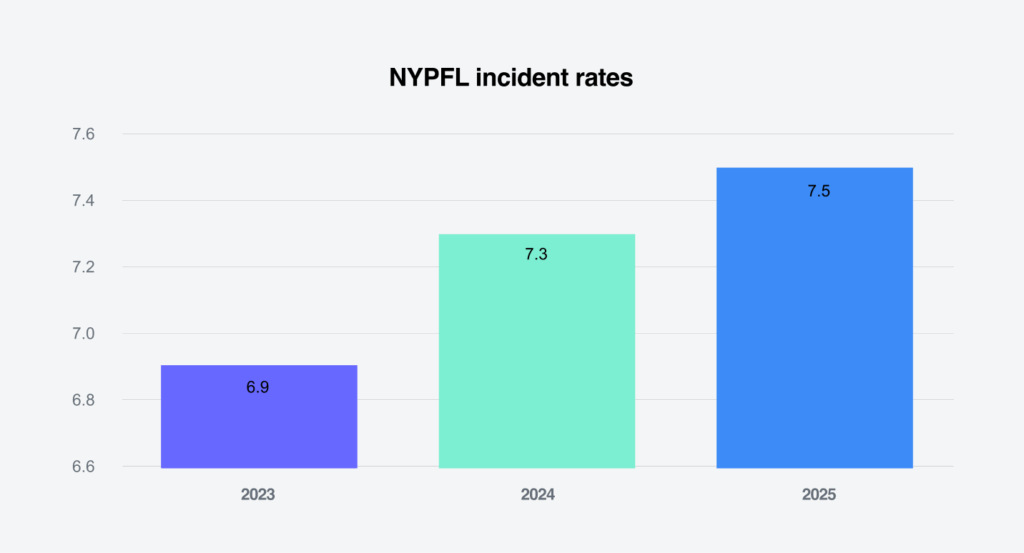
*Data includes clients and headcount for CA where the client has NYPFL benefits eligible.
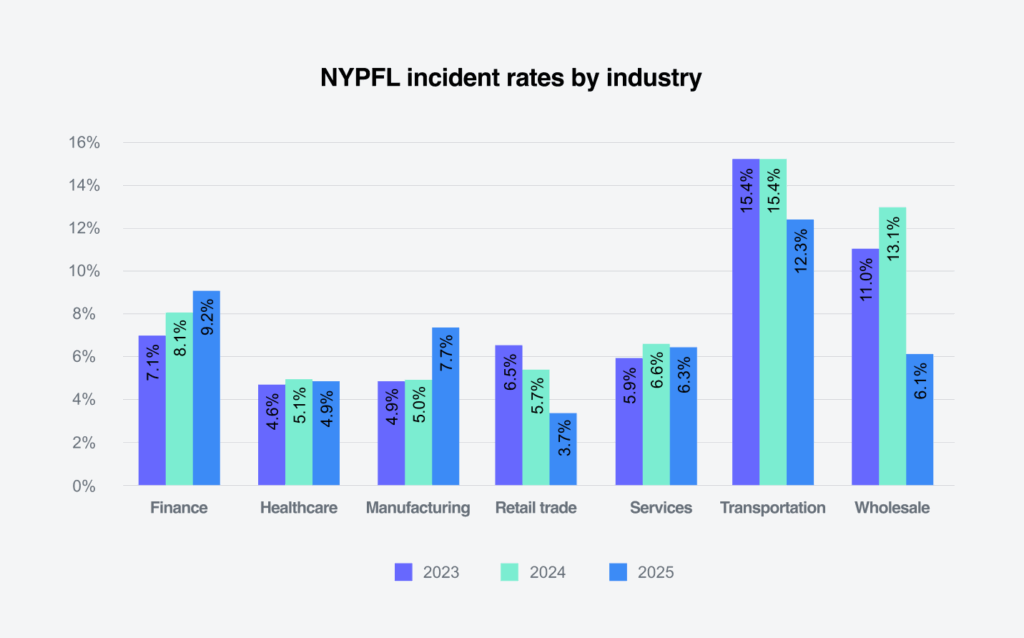
Both the finance and manufacturing sectors saw an increase in incident rates versus 2024, which is consistent with what we’re seeing in other lines of business. Transportation and wholesale trades saw significant decreases, which shows that those industries are shifting as technology may be impacting the sector from a workforce perspective.
The trend we noted at the end of last year with family leave becoming a more robust benefit continues as we saw a 1.3% increase in volume in the first half of 2025. Bonding remained the top leave reason but also showed a 1.4% decrease mid-year. The economic and political headwinds may have families beginning to postpone the decision to start or expand their families. We will continue to watch this trend closely.

California
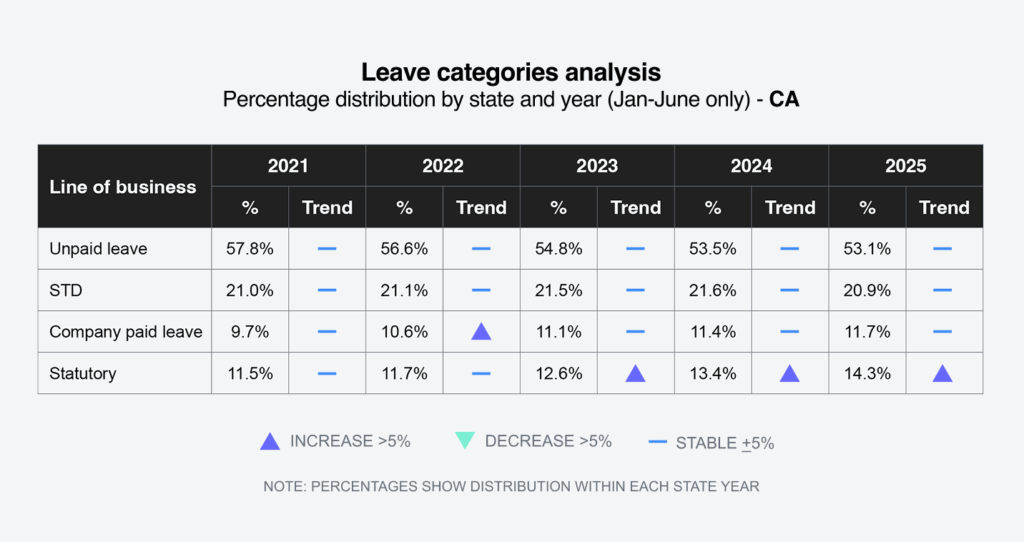
Unlike in New York, we continued to see an increase in usage of statutory programs in California. CAPFL continues to lead the nation in terms of benefit amounts. Claim volumes for company paid leave and short-term disability programs have remained static since 2021.
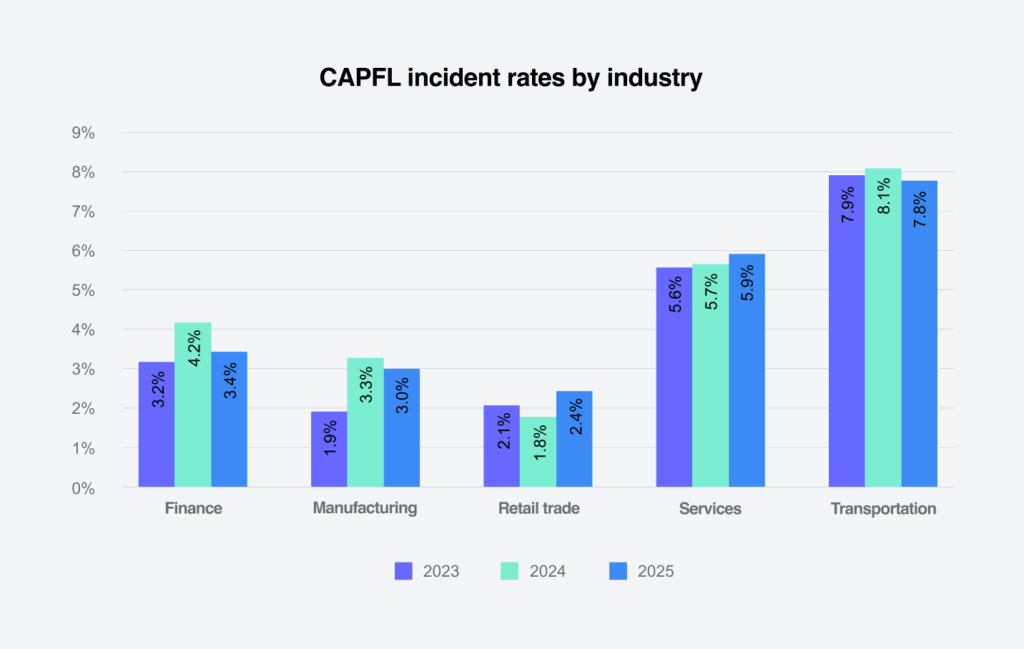
CAPFL incident rates increased for the retail trade and services categories. Unlike in New York, California did not have a population in the wholesale sector large enough to be statistically meaningful. It should be noted that while the transportation sector showed a decrease in California as well, the drop was not as significant as it was in New York.
Care for family members continued to represent almost 30% of all CAPFL claims in terms of overall volumes. When looking at incident rates (and the employees eligible for each claim type), care for family members occurred at a higher rate than bonding.
Future considerations
Expansion of paid leave policies
Paid leave provides financial support and sometimes job protection when employees need time off for a new child or personal or family care. The COVID-19 pandemic highlighted the importance of paid leave, leading to increased support from employers and politicians. While a federal paid leave option is unlikely to pass soon, states continue to establish and expand their programs. Here are some recent state updates:
- Colorado – Effective Jan. 1, 2026, the state is adding 12 weeks of benefits for leave when a child is receiving care in a neonatal intensive care unit. The state has not defined if this will be a new bank of time or another qualifying reason within the current 12-week entitlement.
- Delaware – The Delaware Healthy Families Act becomes effective Jan. 1, 2026.
- Minnesota – The Paid Family and Medical Leave Act becomes effective Jan. 1, 2026.
- Washington — Effective Jan. 1, 2026, employees will be eligible for job protection benefits after 180 days of service, down from 12 months of service, under Washington Paid Family and Medical Leave. In addition, employees will be able to take leave in four-hour increments versus the current eight-hour requirement. The law also allows for employers to limit stacking (running benefits consecutively) in certain cases.
- Maine – The Paid Family and Medical Leave Act becomes effective May 1, 2026.
- Maryland – The Family and Medical Leave Insurance Program becomes effective Jan. 1, 2028.
Wage replacement formulas
Recent state PFML programs use a multipart formula to provide higher wage replacement for lower-wage workers:
- Colorado — 90%
- Connecticut — 95%
- District of Columbia — 90%
- Maine — 90%
- Maryland — 90%
- Massachusetts — 80%
- Minnesota — 90%
- Oregon — 100%
- Washington — 90%

Inclusive definitions of family
Many states have expanded the definition of “family member” to include grandparents, grandchildren, siblings, parents-in-law and domestic partners. Six states also include individuals related by blood or affinity:
- California
- Colorado
- Connecticut
- New Jersey
- Oregon
- Washington
Delaware has not adopted this broader definition, while Minnesota and Maine have included it in their PFML programs.
Appendix
Overall leave
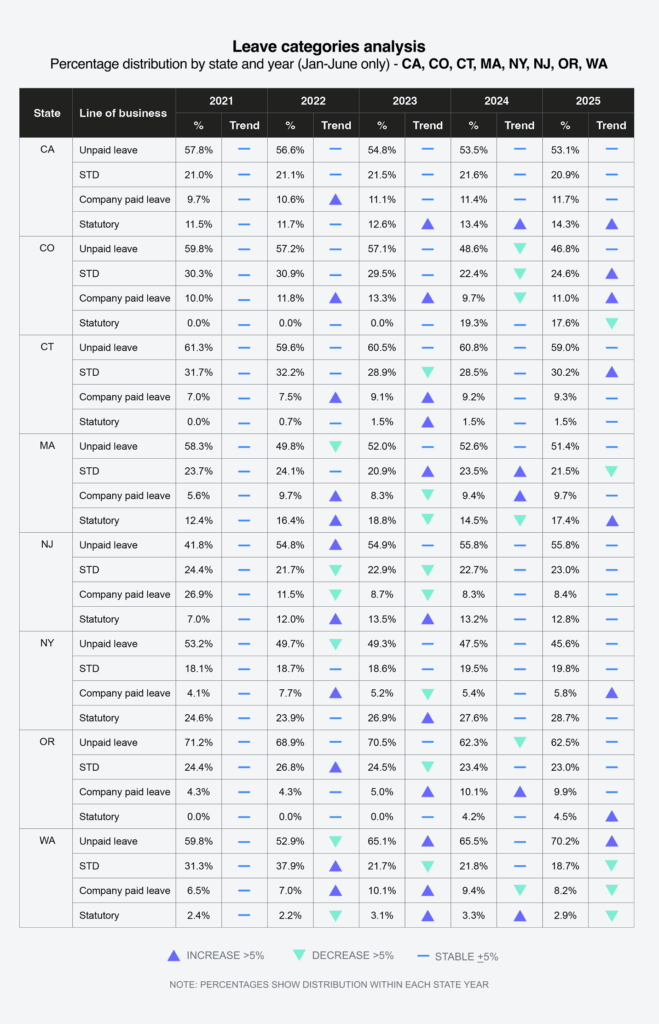
Statutory paid leaves may also have a concurrent short-term disability claim open or an unpaid stand-alone leave opened after paid leave time is exhausted.