

2025 YEAR-END
Accommodations

Report Objectives
This report aims to summarize the present metrics for our disability programs, assess the landscape of disability claim administration and litigation, and benchmark our patterns against comparable industry research.
data parameters
Our practice team uses JURIS claims data to perform comparative analyses informed by their expertise and analytics. The data in this report is based on the calendar year, January through December, for each reporting year.
Certain client data is excluded from book of business metrics to avoid overrepresentation of a single client.
Key observations
Year-end 2025 data shows accommodation activity continued to rise, while leave of absence requests remained the largest share of requests. At-work accommodations expanded, driven by remote and environmental supports, with work-from-home (WFH) increasing year over year and accounting for over half of environmental accommodations. Growth in WFH was strongest among employees aged 25–35, while participation among those under 25 declined.
7.2%
increase in new accommodation volumes in CY 2025, with incident rates rising 5.3% over the prior year.
0.5%
increase in leave of absence accommodations to 59% (up from 58.5%) which remains the largest share of requests.
1.3%
increase in environmental accommodations, to 9.4% (up from 8.1% in 2024).
At-work accommodations
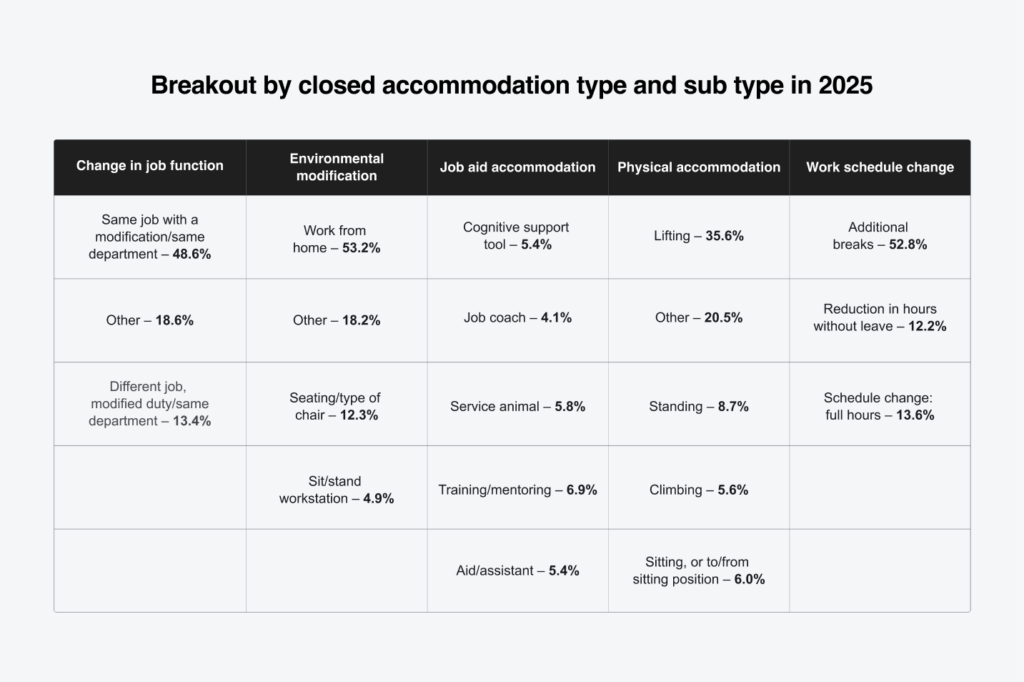
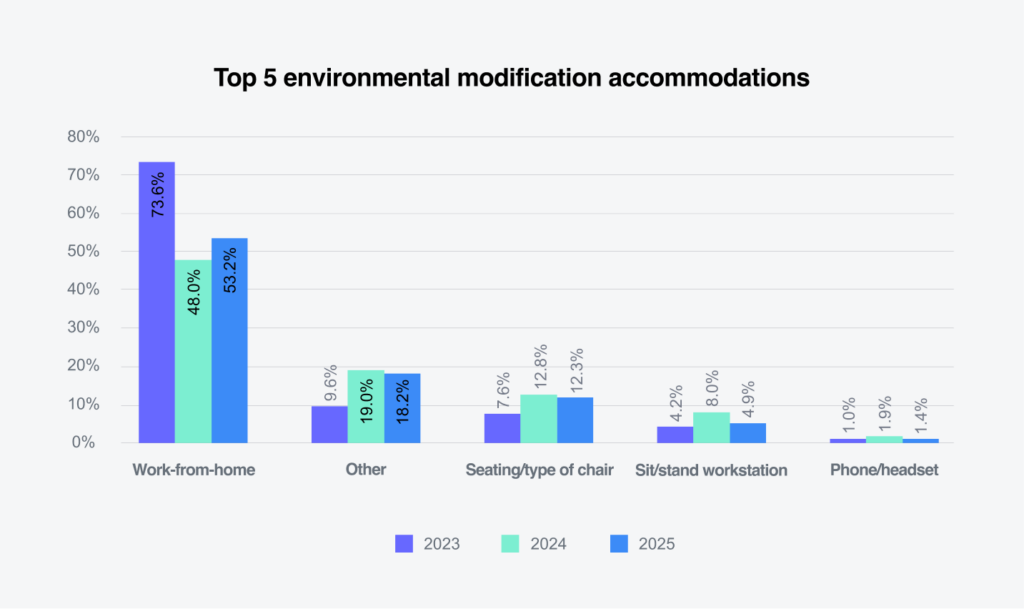
At-work accommodations continue to expand, driven by remote and environmental supports. Physical accommodations remain the largest at-work category, while traditional ergonomic supports (e.g., sit/stand, phone/headset) declined.
53.2%
increase in environmental accommodations like WFH (+5.2 year over year).
Smaller sub‑types such as parking, policy updates and air‑quality improvements show steady incremental growth.
Age insights
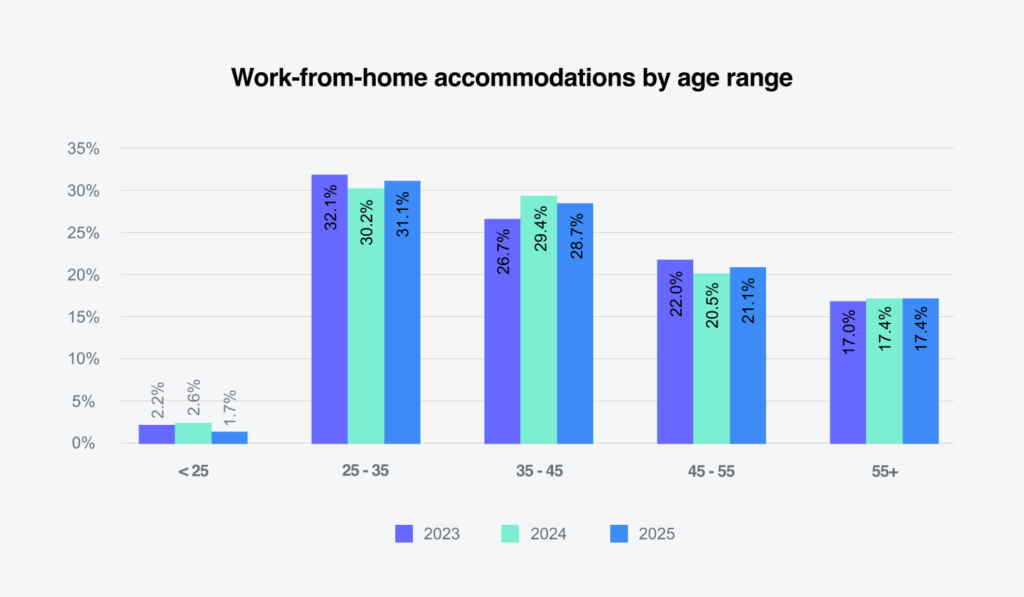
Among WFH accommodations, the 25–35 age group increased 3.1% year over year, while employees under 25 declined from 2.6% in 2024 to 1.7% in 2025.

Download a summary slide with these key observations.
REPORT CONTENTS
New volumes
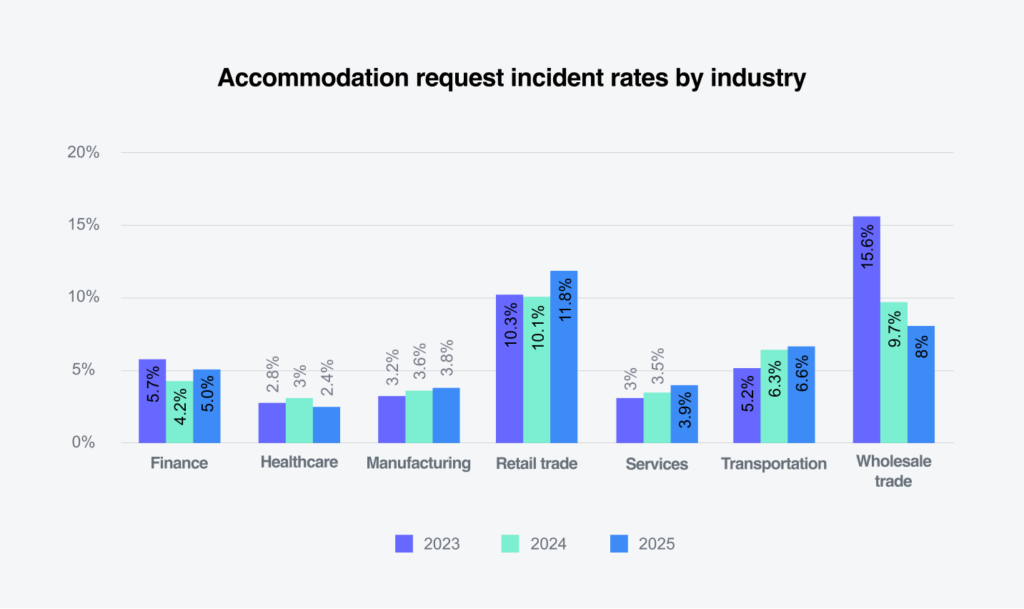
Retail trade
Wholesale trade & healthcare
Incident rates rose 0.3% over 2024. Retail trade recorded the largest increase, with nearly all sectors posting slight year over year gains. Healthcare and wholesale trade showed declines.
Wholesale trade has trended downward for the past two years, a trend expected to continue in 2026. In healthcare, incident rates increased in the third and fourth quarters compared with the 0.58% rate reported at midyear. While still below 2024 levels, rates returned to expected levels for the sector.

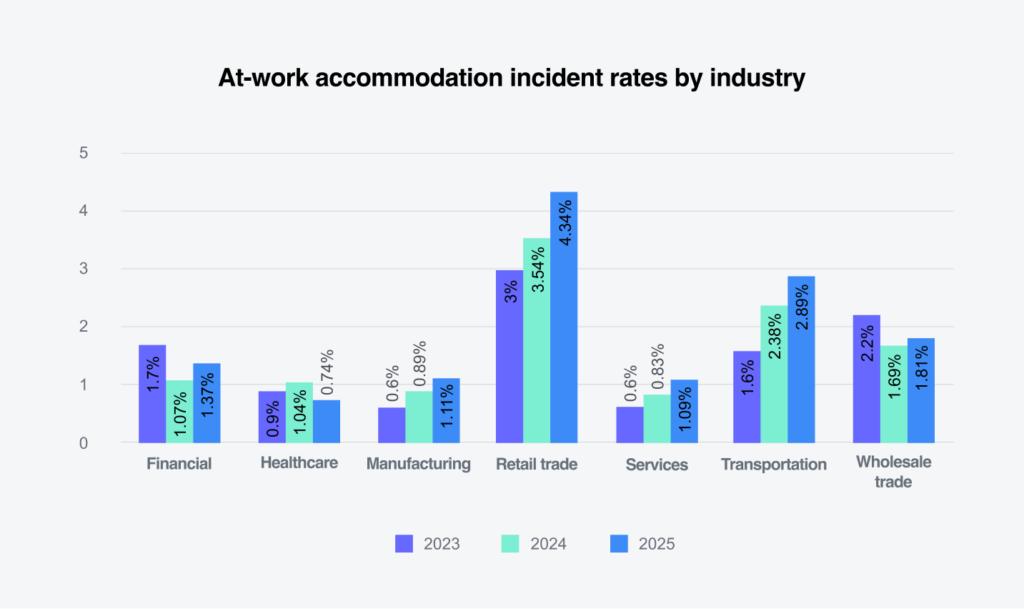
Incident rates
While work-from-home (WFH) accommodation requests remain the most common, at-work accommodations increased year over year in all sectors except healthcare. Retail, transportation and financial services recorded the largest increases from last year. Healthcare trends mirrored the slow start seen in 2025, followed by a sharp increase in the second half of the year.
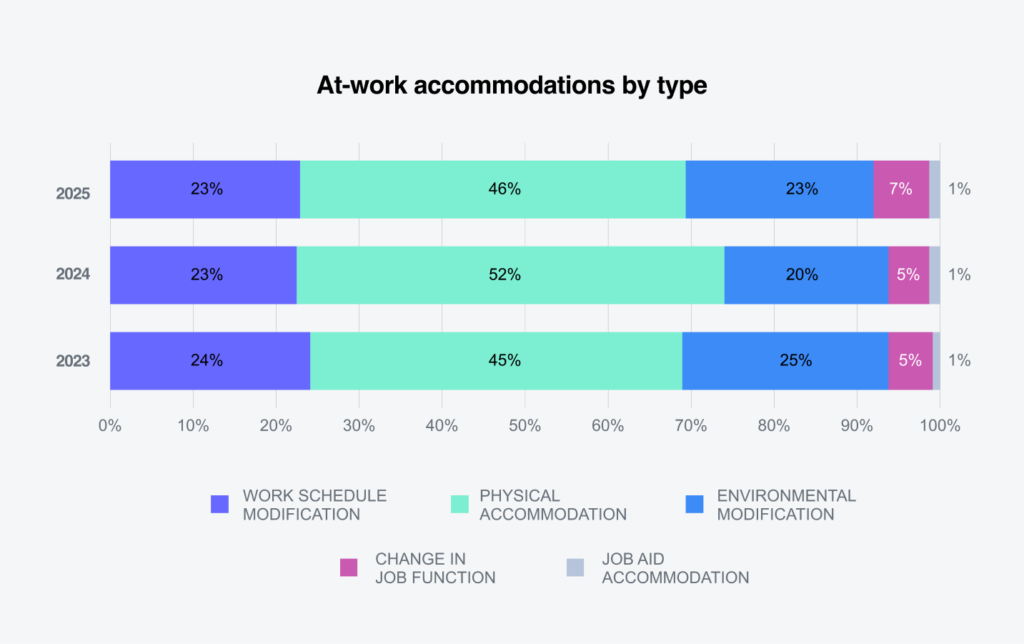
Midway through 2025, physical accommodation requests declined compared with the same period in 2024. Physical accommodations fell 6% year over year, while environmental accommodations and job function changes increased. Given the risk in WFH requests in 2025, this shift is consistent with broader trends. As most employers have adopted hybrid return-to-office strategies, the increase in WFH requests may indicate a continued employee preference for remote work flexibility.
Environmental accommodations
Year-end results were consistent with the 2025 midyear report. As noted, WFH accommodations continued to increase but remained below 2023 levels. The five most common accommodation types each recorded slight declines. Given slower hiring in some sectors due to economic conditions and inflationary pressures, this trend is not unexpected.

Job aid accommodations
Accommodations involving nontraditional support tools represented the largest category of job aid accommodations. These include job coaching, job shadowing and note takers, etc.
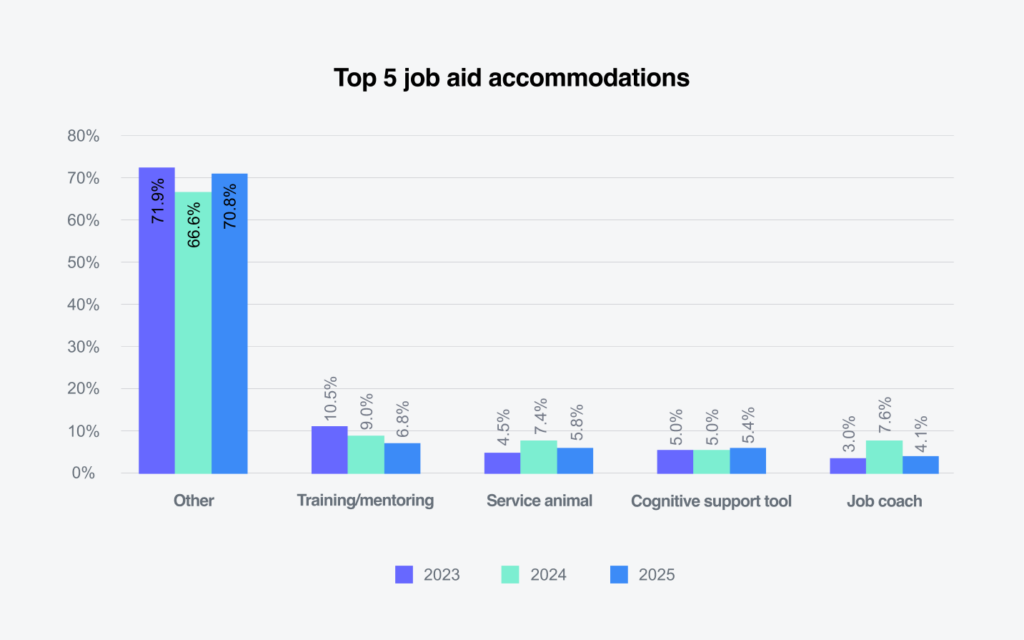
The midyear 2025 State of the Line report showed an increase in requests for service animals; however, year-end data reflected a significant decline in volume, resulting in an overall decrease compared with 2024. This decline may be correlated with the increase in WFH requests.
WFH accommodations by age
Claimants ages 25-35 continued to increase and reached levels last seen in 2023. Claimants ages 35–45 recorded a slight decline from 2024 but remained above 2023 levels, while the 55+ age group remained stable year over year. This trend aligns with an increase in long-term disability claim requests among older workers, suggesting that despite remaining in the workforce longer, some claimants are opting for long-term disability or no longer requiring accommodation requests.
New accommodation requests by length of service
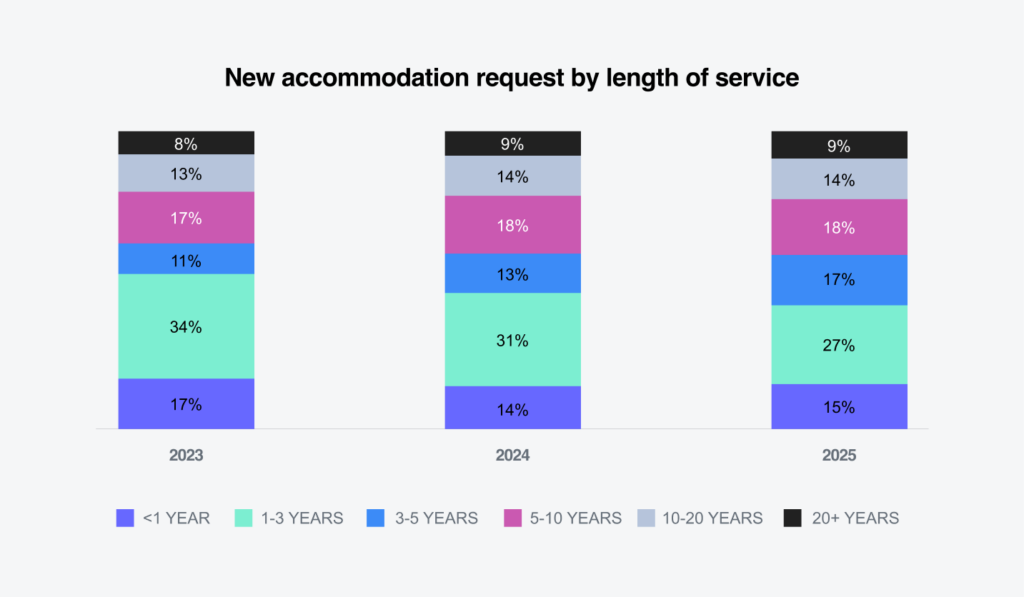
The midyear 2025 trends in accommodation requests remained consistent with year-end results. Claimants with one to three years of service declined 4% year over year, while those with three to five years of service increased 4%. Claimants with less than one year of service showed a slight but consistent increase. Accommodation requests are expected to follow disability and leave patterns, returning to pre-pandemic service-length distributions in 2026.
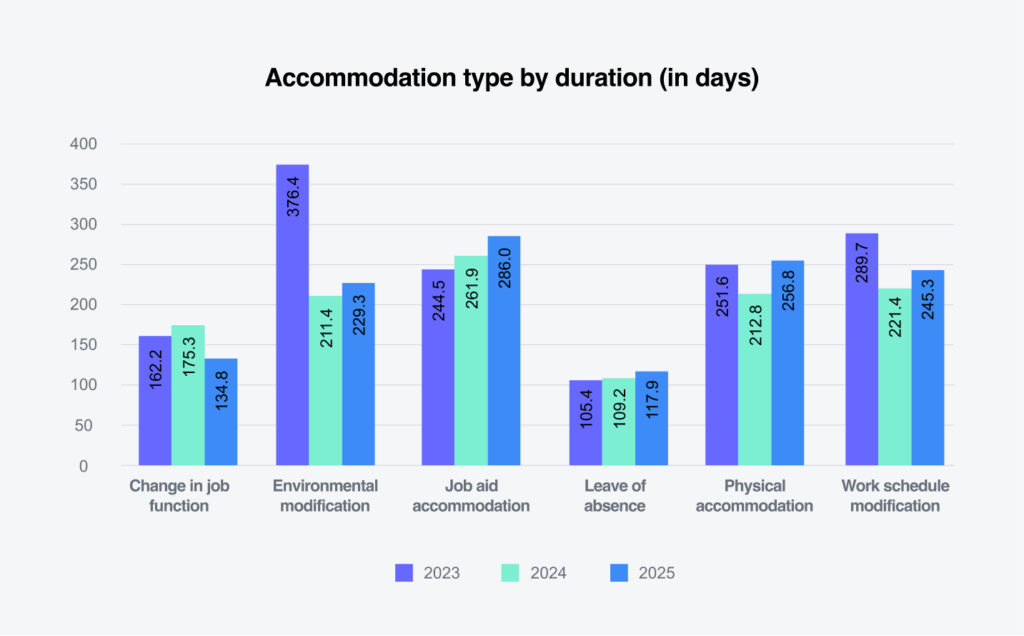
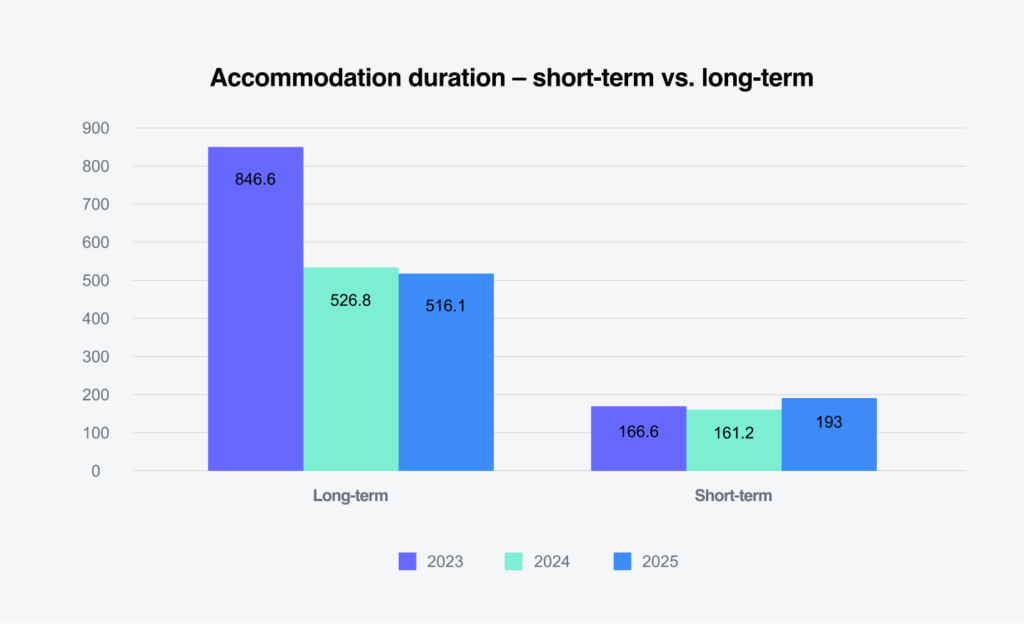
Accommodation durations
The shift from long-term to short-term accommodation durations narrowed from 305% at mid-year 2025 to 267% by year-end, a trend observed across all industries.
Accommodation durations increased modestly across all categories except change in job function. While environmental accommodations and work schedule modifications rose, both remained below 2023 levels. In contrast, job aid accommodations remained well above 2023 levels.
Future considerations

EEOC changes
The Equal Employment Opportunity Commission (EEOC) now has a full slate of commissioners following the appointment of Andrea Lucas as chair. The commission has begun restructuring its priorities and has rescinded several Biden-era policies. Among the most significant changes was a January 2026 vote requiring full commission approval for most litigation. This shift could significantly affect the types of cases the EEOC pursues and may reduce accommodation-related lawsuits filed on behalf of claimants, as regional offices no longer have independent authority to initiate litigation.
Litigation trends
As part of its realignment of priorities, the EEOC is deprioritizing enforcement actions based on disparate impact and shifting its focus to individual discrimination claims. This approach signals that cases will be evaluated on their individual merits rather than through a broader systemic lens.
Among the priority areas are cases involving mental health and remote work accommodations. Given the increase in work-from-home requests, this focus is expected to continue in the coming years. The commission has also indicated it will maintain separate accommodation processes under the Pregnant Workers Fairness Act for pregnancy-related conditions. As a result, states may move to reinforce pregnancy protection requirements in response to this direction.
In 2025, the EEOC filed 93 lawsuits, the lowest total in the past decade. Most cases centered on religious freedom claims, accommodation disputes, and reviews of diversity, equity and inclusion-related practices.
The commission has signaled that it is pursuing an “America First” agenda as outlined by the current administration. As such, the EEOC is ramping up reviews of reverse discrimination rather than focusing on traditional race-based discrimination.
Election trends
The year 2026 marks the midpoint of the current administration, with midterm elections scheduled for November. While outcomes remain uncertain, midterm elections have historically resulted in the party in power losing seats in both the House and Senate. Given narrow majorities in both chambers, one or both could shift to Democratic control.
If that occurs, Congress could move to limit or require changes to the Equal Employment Opportunity Commission’s current approach. Any resulting policy or enforcement changes would likely not take effect until mid to late 2027.
2025 YEAR-END